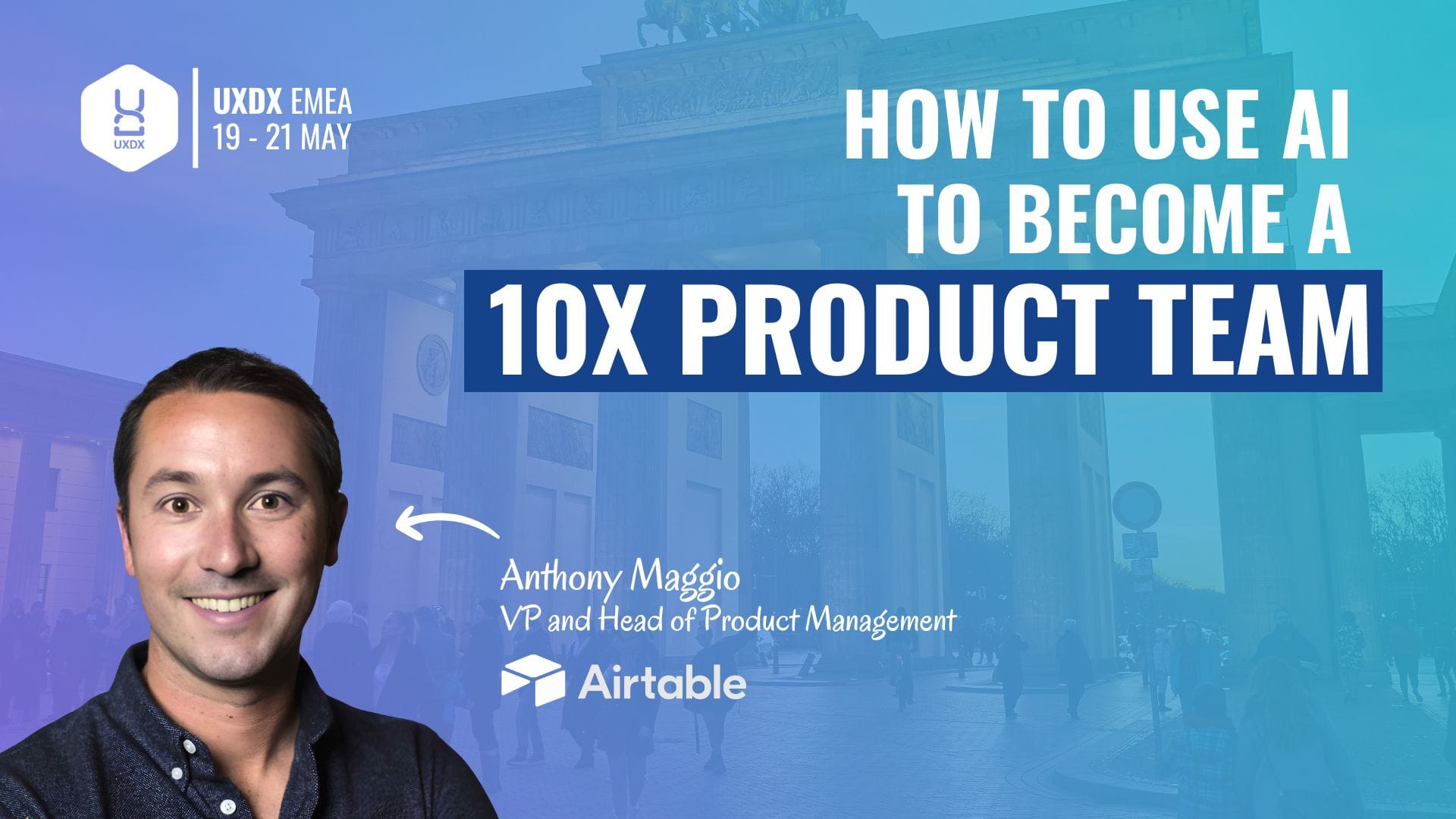
How to use AI to become a 10x Product Team
Product teams are standing at the edge of a seismic shift. The ones who thrive will be those who build at the frontier of AI capability, compress product cycles from months to minutes, and think beyond their remit acting as AI general managers across the business, not just their product lines.
When Anthony Maggio, VP and Head of Product Management at Airtable, took the stage in Berlin, he didn’t talk about AI as hype or threat. He talked about practice. Drawing on hundreds of conversations with product leaders and Airtable’s own experiments, he laid out a pragmatic vision of how product teams can use AI not only to accelerate but to amplify their impact.
His message was clear: product teams sit in the perfect position to unlock AI’s real value. They understand customer problems, data, and processes. But to become what he calls 10x teams, they need to work at the edge of what AI can do, rebuild their rhythms around speed, and think beyond product lines to the wider business.
Operating at the Frontier
Anthony began with a reminder of just how fast AI capabilities are advancing. Using the GPQA Diamond benchmark, a test for reasoning performance, he showed how, in less than a year, models have gone from performing slightly better than human PhDs to outperforming them in their own areas of expertise. The takeaway was simple: the ground under our feet is moving faster than most teams realise.
“I’m constantly surprised by how many people still don’t realise just how capable these models are,” he said. “We can’t treat AI as a one-time learning curve. It’s a constant practice.”
At Airtable, his team learned this firsthand. Last year, they began developing an AI assistant that could answer natural language questions about data in any Airtable app. Early versions struggled. “It could summarise, but it didn’t truly analyse,” Anthony recalled. “It wasn’t giving us the insights we needed.”
Then they switched to Anthropic’s 3.7 Sonnet model, and the product transformed overnight. The assistant went from returning surface-level summaries to producing nuanced, context-aware insights. “Suddenly, it could reason,” he said. “It could interpret intent, plan its own steps, and answer with depth.”
For Anthony, that shift captured a critical truth: product teams need to operate right at the frontier of AI capability. If you’re working at the edge of what today’s models can do, you’re in the right place because tomorrow, that edge will move, and your product will already be ahead.
Embracing the Cycle Collapse
Anthony’s second principle tackled something every product team understands: the struggle to move fast enough. “For most of my career, we measured product cycles in weeks or months,” he said. “That’s about to disappear.”
AI, he argued, is collapsing the traditional development cycle, turning ideas into working software in minutes rather than months. “It’s the biggest shift I’ve seen in 15 years of product work,” he told the audience.
At Airtable, that shift is visible in how teams design new interfaces. Historically, it could take weeks to create and test new visual layouts. Now, with what Anthony called “vibe coding,” teams can describe a layout in natural language and let AI generate it instantly. In one co-development project with a retailer, a map-based dashboard was created, tested, and redesigned in under an hour, something that once took a sprint.
“AI removes the bottlenecks that used to feel permanent,” he said. “This isn’t just about speed, it’s about freeing time to focus on learning and creativity.”
For Anthony, this “cycle collapse” represents a long-awaited realisation of agile’s original promise. Instead of just working iteratively, teams can now learn iteratively at a completely different scale. “We’ve been trying to get to working software faster for decades,” he said. “Now we finally can.”
Thinking Like an AI General Manager
The final principle pushed beyond product design. Anthony urged teams to “think like AI general managers,” looking across their organisations for places where AI can compound value over time.
He cited a Goldman Sachs report showing that while many companies are investing in AI, few are capturing meaningful gains. The problem isn’t capability, it’s application. Most organisations, he said, are using AI for one-off productivity boosts rather than embedding it into core, recurring processes.
That’s where product teams come in. Because they already experiment with AI in their own workflows, they’re often best positioned to help other functions do the same. Anthony shared a story from a major shoe company whose e-commerce PM realised her team’s biggest bottleneck wasn’t in product at all, it was in marketing.
“They had to localise every campaign for 90 different regions,” he said. “It was slow, painful, and repetitive.” Instead of standing back, she helped her creative colleagues build an AI-powered pipeline that automatically generated regionalised assets and translated copy. “It didn’t take jobs; it gave people their time back,” Anthony said. “And it hit their revenue goals faster.”
This, he argued, is the next evolution of the product mindset. “You can’t stop where your software ends. You have to think about what happens before launch, after launch, and across the business.” Product teams, he said, are already the early adopters of AI inside most companies; they should also be the catalysts that bring those lessons to everyone else.
Leading with Empathy and Curiosity
When asked how to balance this drive for automation with empathy for colleagues whose work might change, Anthony’s response was pragmatic. “Start with the work nobody wants to do,” he said. “Most people aren’t afraid of losing that part of their job; they’re relieved.” The key, he explained, is to collaborate with teams rather than impose solutions on them. “Your role isn’t to automate people out, it’s to show them what’s possible.”
He also addressed the question of entry-level opportunities in an AI-powered world. Surprisingly, he said, early-career product managers are often the most advanced users of AI. “They’re not limited by how things have always been done,” he noted. “They experiment freely, and it’s paying off.” For Anthony, this reinforces that adaptability, not seniority, will define who thrives in the AI era.
The Moment to Lead
Anthony closed with a line from Nvidia’s Jensen Huang: “AI won’t take your job, but the person who uses AI will.” In the product, that shift is already underway. “This is the moment to lead,” he said. “The people who use AI to learn faster, ship faster, and think broader will define the next decade of product management.”
His three principles operating at the frontier, embracing the cycle collapse, and thinking like an AI general manager form a simple but powerful roadmap for teams ready to evolve.
For Anthony, becoming a 10x product team isn’t about doing ten times more work. It’s about reimagining what’s possible when human insight and machine intelligence move in sync. “AI isn’t here to replace product teams,” he said. “It’s here to make them the most impactful teams their companies have ever seen.”
Want to watch the full talk?
You can find it here on UXDX: https://uxdx.com/session/how-to-use-ai-to-become-a-10x-product-team/?utm_source=Website&utm_medium=Blog&utm_campaign=Post+Conference+Highlights
Or explore all the insights in the UXDX USA 2025 Post Show Report: https://uxdx.com/post-show-report/?utm_source=LinkedIn&utm_medium=Snippet&utm_campaign=Post+Show+Report