Data Science at The New York Times
“Optimising for the right thing is a good idea. Optimising for the wrong thing is a bad idea.”
Chris Wiggins began with an image that felt nostalgic and slightly brutal. The original New York Times experience was a newspaper, a “dead tree” spread across a kitchen table. Readers navigated by memory and layout.
Digital changed that. On 22/01/1996, the Times launched its website, and the product became a set of experiences across desktop, mobile, apps, audio, and a bundle that includes Cooking, Games, Wirecutter, and, as of 2022, Wordle. With those experiences came abundant behavioural data. Chris’s talk was about turning that data into better decisions, without losing the human intent behind the numbers.
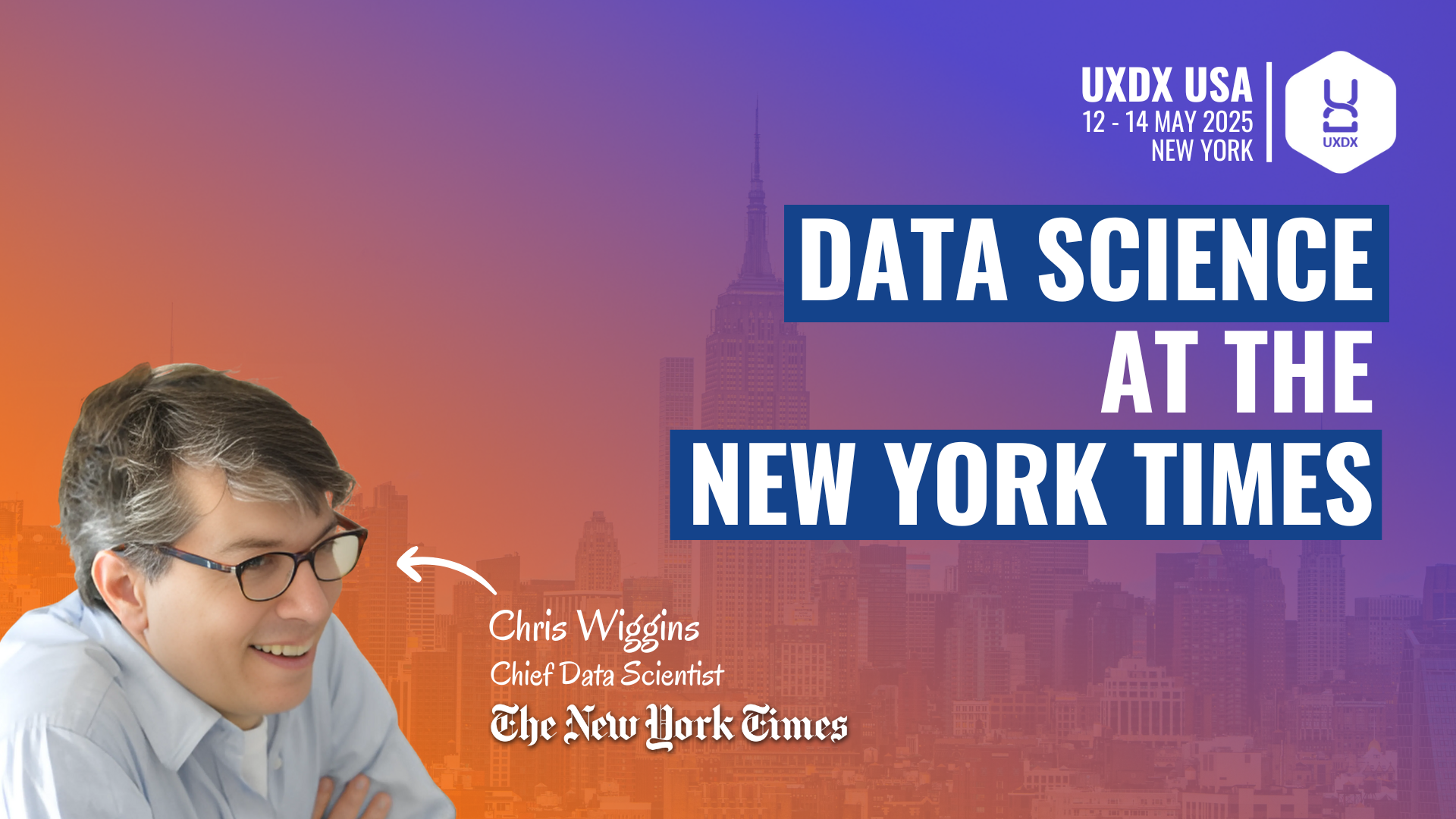
Chris is Chief Data Scientist at The New York Times and an Associate Professor of Mathematics at Columbia. He read the room: designers, data scientists, and people who wished their company had a data scientist. His goal was straightforward: make it easier for multidisciplinary teams to work together, and make it clearer what “adding value” looks like from a data science lens.
Where data science sits, and why it matters
At the Times, the org chart begins with church and state. The newsroom creates journalism. Chris’s team sits on the business side, focused on subscriptions, retention, and discovery that keep the organisation economically strong. That boundary is not a footnote. It shapes how you define success and how you avoid optimising yourself into a corner.
The paywall as a product system
Chris’s first story was the paywall. Introduced in 2011 and widely mocked as doomed, it became central to the Times’ subscription model. The real challenge is not putting up a wall. It is tuning friction so you grow subscriptions while still letting people experience enough value to build a habit.
He modelled the paywall as a funnel. Many arrive. Some register. Fewer pay. If you maximise starts aggressively, you may reduce exploration. If you maximise exploration, you may delay conversion. The question becomes how to balance the two without guesswork.
Prediction versus prescription
Chris’s favourite distinction is prediction versus prescription. Prediction is “what will happen without intervention?” Prescription is “what should we do to change the outcome?” Predicting who is at risk of cancelling is less useful than identifying risky behaviours and the interventions that reduce churn. In product terms, the value is rarely the list. The value is the action.
Prescription forces alignment on outcomes, levers, and tradeoffs. It also forces a step that many organisations avoid: experimentation.
Why experiments come first
Chris described A/B testing and broader randomised controlled trials, often with many variants, as the basis for learning causal impact. In paywall terms, that might mean randomly varying how much access different groups get, or when you prompt for registration. Without interventions, you are largely predicting behaviour in a world you never change.
Those experiments let the team map a tradeoff curve between engagement and starts. Chris then described a real-time paywall model, nicknamed Raptors, that can tune between those objectives. The memorable part was not the maths, but the operating rhythm: teams could literally adjust priorities by turning a dial, rather than relitigating the argument every quarter. Chris even mentioned “knob meetings” where they decided where to set that dial for the month.
Recommendations and bandits
From paywalls, Chris moved to recommendations. The first “Recommended for you” widget arrived in 2011 as a generic feed. Over time, the mindset became: define the outcome, then design an algorithm that can improve it within agreed constraints.
This is where he introduced contextual multi-armed bandits. Rather than running a fixed A/B test for weeks and then choosing a winner in a meeting, a bandit approach adapts while learning, allocating more traffic to what appears to work. The practical appeal is speed and less wasted exposure to weak options. The organisational appeal is even bigger: agree on what you are optimising, and you reduce KPI politics.
Working with editors: jobs to be done and guardrails
At the Times, “agreeing on the outcome” happens with editors. Chris described a model of partnership built around jobs to be done. The homepage and article pages are modular: different modules serve different reader intents, such as hard news, opinion, lifestyle, or sub-brands like Cooking and Wirecutter. Each module has an eligible content set, an agreed success score, and business rules applied as guardrails.
The endgame is self-serve tooling. Editors should be able to nominate an appropriate set of articles and let the algorithm rank within those boundaries without waiting for a data scientist. Chris gave a vivid example: breaking news like the death of the Queen, where coverage evolves quickly, and promotion needs to shift in real time. Self-serve tools kept the system responsive without becoming dependent on a single team’s availability.
Hard truths: slow metrics and workflow fit
Chris was candid about constraints. Subscription metrics are slow, and by the time you learn who stayed for six months, behaviour and products can change. That pushes teams toward continual experimentation and explicit tradeoffs, not faith in one perfect metric.
He also described a painful but familiar lesson: building something technically impressive that no one can integrate. Early on, the team sometimes spent months building a complex solution only to have an internal user respond with a polite “That’s interesting". The fix is an internal product mindset: build in slices, validate adoption early, and only then scale sophistication.
Another thread running through the talk was the role of qualitative insight. Chris described trying to capture notions like editorial importance by learning from how editors themselves promote stories, then validating the rankings with real conversations rather than treating the score as truth. He also described borrowing UXR habits when building internal tools: shadow the people who will use them, share rough versions early, and keep asking a simple question, can this fit into your workflow tomorrow. For data science teams, that translation from human feedback into model changes is as important as any algorithm.
Ethics, hype, and foundations
In questions, Chris addressed ethics through shared vocabulary: rights, harms, and justice. Journalism adds its own principles, like trust and transparency. The work is reconciling them in systems that shape attention, and monitoring impact over time rather than relying on a one-off checklist.
He also pointed to the current AI hype cycle. Attention spiked in late 2022, but different teams are still at different points of excitement and disillusionment, making alignment harder than usual. His advice was quietly conservative: build fundamentals first. Data engineering, reliable pipelines, and the ability to run experiments matter more than flashy demos.
The takeaway
Chris closed by describing the kind of team that survives this complexity: varied disciplines, strong communicators, and an internal product mindset. He also pointed to two books he wrote during the pandemic, one focused on the history and ethics of data and one more technical, focused on putting data to work in products.
For product and design leaders, the takeaway is simple. Data science creates the most value when it helps you decide what to do, not just predict what will happen. That requires experiments, shared definitions of success, and tools that fit real workflows. Done well, it turns data from a rear-view mirror into a decision system.
Want to watch the full talk?
You can find it here on UXDX: https://uxdx.com/session/data-science-at-the-new-york-times1/
Or explore all the insights in the UXDX USA 2025 Post Show Report: https://uxdx.com/post-show-report